
Battle of the Sexes: How Men and Women View Money
It’s been well-documented the differences between women and men, and money habits are no exception. Differing opinions on spending and saving are likely some of the biggest reasons why money is the most common reason married couples fight, with couples averaging three arguments per month about financial issues. Additionally, 3 in 10 married adults admit to potentially deceitful behavior about money, and arguments about money are the most common predictors of a future divorce. The question is, why is money such a sensitive topic?

By Kari McLeod, Pangaro Wealth Management
It’s been well-documented the differences between women and men, and money habits are no exception. Differing opinions on spending and saving are likely some of the biggest reasons why money is the most common reason married couples fight, with couples averaging three arguments per month about financial issues. Additionally, 3 in 10 married adults admit to potentially deceitful behavior about money, and arguments about money are the most common predictors of a future divorce. The question is, why is money such a sensitive topic?
The Differing Outlooks On Money
One of the big reasons why money can cause friction in a relationship is that men and women view saving and finances differently. Men are more likely to take risks with money than women. Motivational speaker and budgeting expert, Dave Ramsey, explains that men use money as a scorecard, whereas women see it as a security issue. As a result, women may experience a higher level of fear when money problems arise.
Women who invest tend to do so more conservatively than their male counterpart and, perhaps because they generally earn less than men, they are more interested in long-term planning, saving, and living more frugally in order to feel more secure.
Another study shows that women are more astute consumers, in that they’re more likely to invest time and energy to research and compare their options. Men, on the other hand, are willing to pay extra to expedite the process. And while women may be more likely to purchase things they don’t necessarily need, men are more likely to spend more money than women on daily needs, such as food, transportation, and entertainment.
Potential Financial Hurdles in Relationships
Beyond differing outlooks on money, some couples may experience shame, secrecy, and resentment regarding spending. According to a CreditCards.com poll, 1 in 5 Americans have spent $500 or more without their partner’s knowledge, and 6% have maintained hidden bank accounts or used secret credit cards. This is most often done so a spouse can avoid conflict within his or her relationship.
What makes money and love so difficult to peacefully coexist? For one, money will always be an emotional topic for people. It seems that just about everyone has their own opinion on how to manage money and what constitutes “good” financial behaviors versus “bad.” Even among a happily married couple, differing financial philosophies can clash and cause tension. Additionally, money can be a difficult subject to broach as it easily incites stress or frustration, so many couples attempt to avoid conversations on finance at all costs.
Communicating About Money
Despite the trend, money doesn’t have to be a pain point in a relationship. Let’s look at a few simple strategies that may help couples avoid financial arguments.
Be Open About Your Spending
You and your spouse should be aware of how you spend your money, especially when it comes to significant costs, loans, or ongoing fees. Maintaining an open line of communication regarding upcoming bills may help you avoid confrontation. If you want to make a big purchase or spent more recently, talk to your spouse about it.
Create Guidelines and Boundaries
It’s important for a couple to be on the same page regarding their finances. It can be helpful to answer some basic questions to establish what you consider necessities and what price-point is “too much.” For example, how much can be spent per month on non-essentials? How much is too much for a new pair of shoes?
Establish some basic structure for how you will spend and save money. If one of you is more disciplined than the other, you may consider having the disciplined spouse manage the monthly budget and spending.
Maintain Transparency
Most often, one spouse manages all of the household’s bills, budgets, savings, investments, and insurance policies. However, it can be helpful for both partners to understand their spending versus their saving. Sit down together once a month to review your credit card statements, account transactions, and other bills. This helps you both recognize any spending patterns and stay on the same track with your financial goals.
Get Help From an Unbiased Third-Party
Sometimes the best way to ease money tensions is to work with an objective third-party, whether that’s a financial advisor, a marriage counselor, or both. A financial advisor can work with you and your spouse together to review your financial landscape, identify any gaps in your coverage, assist you in establishing short and long-term goals, help you stay on track, and provide professional and knowledgeable advice.
Although the topic of money can occasionally cause tension, it doesn’t have to become a constant cause for concern in a relationship. Invest the time to address spending habits and savings goals, uphold transparency regarding bills, and communicate effectively.
As a financial advisor who specializes in working with women, I enjoy helping couples and helping them establish healthy financial habits, work through life transitions, and pursue their goals. If you have questions about your financial situation or more ways to communicate about money, I’d be happy to help. Give my office a call at 203.439.2626.
About Pangaro Wealth Management
Pangaro Wealth Management is a Registered Investment Advisory firm providing financial planning, risk management, and retirement plan consulting for individuals, families, and business owners. Led by a team of experienced financial professionals with diverse backgrounds, the firm focuses on doing one thing extremely well and with unparalleled dedication and commitment: connecting their clients’ dreams with sound financial strategies. By collaborating as a team, they provide greater depth and more advanced strategizing to clients’ plans and needs. Deeply rooted in their community, they serve clients throughout Connecticut, reaching to Cheshire, Meriden, New Haven, Torrington, Avon, West Hartford, Farmington Valley, Vernon, and beyond. To schedule an appointment, click here. To learn more about their services, visit www.pangarowealthmanagement.com or connect with them on LinkedIn.
Have questions or need help? Book a phone call or meeting using our online calendar now!
Who I Am and How I Can Help
While everyone changes and evolves as we get older, there are two things that have remained constant throughout my life: a strong pull towards personal finance and a passion for helping people. I discovered my natural knack for numbers and interest in financial literacy in high school and in college. After graduating, however, I wasn’t inspired by the industry’s structure at that point. Independent advisors weren’t as common and I didn’t want to become a stockbroker or financial representative with a big corporate that required me to fulfill quotas or push clients into certain products. I instead chose to pursue a career a role in financial reporting and analysis in the retirement services industry.
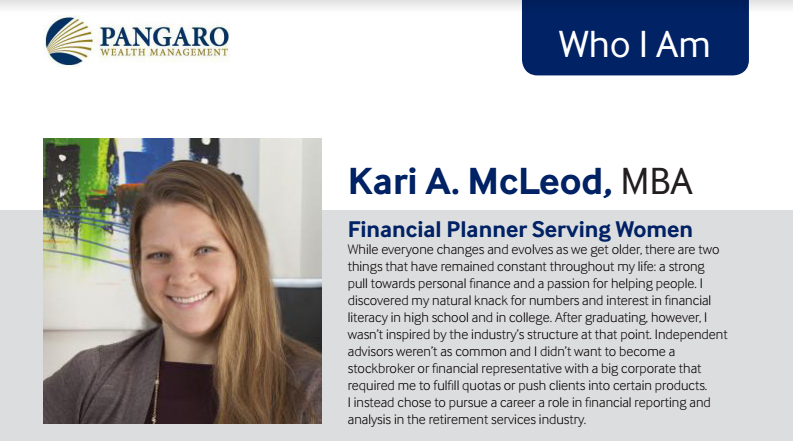
While everyone changes and evolves as we get older, there are two things that have remained constant throughout my life: a strong pull towards personal finance and a passion for helping people. I discovered my natural knack for numbers and interest in financial literacy in high school and in college. After graduating, however, I wasn’t inspired by the industry’s structure at that point. Independent advisors weren’t as common and I didn’t want to become a stockbroker or financial representative with a big corporate that required me to fulfill quotas or push clients into certain products. I instead chose to pursue a career a role in financial reporting and analysis in the retirement services industry. Learn more here.

Happy Halloween! Does Financial Planning Scare You?
Happy Halloween from Pangaro Wealth Management! Whether or not you have kids, it’s hard to deny the thrill of carved pumpkins, sugary treats, and dressed up ghosts and goblins. But for some, Halloween is just plain spooky.

Happy Halloween from Pangaro Wealth Management! Whether or not you have kids, it’s hard to deny the thrill of carved pumpkins, sugary treats, and dressed up ghosts and goblins. But for some, Halloween is just plain spooky.
Just as some of us shy away from the Halloween season, too many people do the same with financial planning. Women, especially, cannot afford to ignore their financial future. Here are some “scary” facts that prove how critical it is for women to make financial planning a priority:
For 80% of households in the U.S., women are the primary decision-makers when it comes to making purchases.
Women earn approximately 80% of what men make.
Most women spend 15% of their working years taking care of children or elderly parents, cutting into their prime retirement savings years.
Only 20% of women feel “very prepared” to make wise financial decisions. Half indicate that they “need some help,” and one-third believes that they “need a lot of help.” (1)
Your financial future doesn’t have to be scary. Let’s look at the importance of financial planning regardless of your personal situation.
Why It’s Harmful to Delay Financial Planning
Most of us visit our doctor at least once a year. We get vaccinations to prevent diseases, checkups to nip any blossoming issues in the bud, and medications or tips on how to fight illnesses. It’s crucial for us to view our financial health in the same way so we can plan ahead for the future and employ strategies to overcome obstacles.
Just as you shouldn’t self-diagnose yourself medically, you also shouldn’t try to problem-solve your finances alone. It can be challenging to know what you’re doing incorrectly (or what you can do better) with your money if you aren’t an advisor. It can be difficult to get on track with finances, whether it’s budgeting, creating a savings plan, or investing.
According to a study by the National Association of Personal Financial Advisors (NAPFA), 56% of U.S. adults don’t have a budget, 39% don’t have any non-retirement savings, and 50% with children don’t have a will. This lack of financial preparedness can create a lot of hiccups down the road and cause you to have more questions than ever.
How Financial Planning Can Help
Financial planning not only helps you implement strategies to maximize your savings and boost your asset growth, but it can make you feel more confident in your future, make more informed decisions, and answer important life questions, such as:
When can I retire?
Do I have enough money to buy a home?
Do I need life insurance and disability insurance?
What are my spending habits?
How much do I need to save to reach my long-term goals?
While you may be able to address some of these questions yourself, most people lack the time and energy to do so, and it can be hard to look at your situation with an objective eye. That’s why many people consult with an independent financial advisor who can provide education, guidance, and unbiased advice.
Financial Planning For Every Age
Let’s turn our attention to a few of the significant planning needs that occur at different stages of life:
In Your 20s
You may be just starting out in your career, but now is the time to start saving for retirement. Consider it an essential expense, on the same level as your rent, utilities, and cell phone bill. The earlier you start saving for retirement, the more you can benefit from compound interest. According to a study conducted by TransAmerica Center, 25% of women who have access to an employee-funded retirement plan do not utilize it. (2) This is the time to maximize any contributions.
Along with saving for retirement, your 20s are the time for you set the best financial pattern in terms of budgeting, especially if you eventually want to purchase a home, travel, or make another large purchase.
In Your 30s
When you are in your 30s, you’ll need to evaluate where your career is going, whether you want to settle down in your home, if you’re ready to start a family, and how to pay off student loan debt more aggressively.
A financial advisor can help you budget for a growing family and potential work time lost, evaluate mortgage rates and the costs of selling and buying a new home, tackle debt while still saving for retirement, and more. And if children are in the cards, it may be time to look at your disability and life insurance options.
In Your 40s
At this point in life, many parents find themselves at a crossroad with the challenge of saving for your retirement and also saving for your children’s college tuition. It's a fragile balance because you don’t want to put your retirement at risk to cover expensive tuition costs. This is an important time in life to look at college planning opportunities and get your financial house in order.
If you don’t have kids, this is a good time to get ahead on your mortgage and any other significant debts. The goal is to pay off as many loans as possible before you reach your retirement years.
In Your 50s
In this decade, you’re quickly approaching your retirement years, and this means it’s time to get serious about your future needs. Beyond your disability and life insurance, does it make sense to consider long-term care insurance?
This is also the decade to explore exit planning (if you run a business), potentially rollover any 401(k) plans into IRAs, make sure you have a current will in place, and evaluate your retirement lifestyle, including where you’ll live and what you’ll do with your time.
In Your 60s
Along with solidifying your retirement income and solving any cash flow problems, this is a critical time for Social Security planning. There are a lot of strategies involved to help you claim when it makes the most sense for you while still receiving the maximum benefits.
Along with Social Security, you’ll need to determine when you’ll withdraw from your 401(k) or IRAs, how to maintain a consistent income, and work to make sure you have an estate plan in place.
In Your 70s, 80s, and Beyond
Age 70 is a big year. At 70, you’ll need to start taking Social Security payments (if you haven’t already done so). And at 70½, you’ll have to start taking distributions from your IRAs and previous employer 401(k)s (if you haven’t started yet).
Throughout the decades, you’ll want to keep an eye on your spending, maintain your health, and regularly update or review your will and estate plan.
Although Halloween can be scary, financial planning doesn’t have to be!
Ready to Start?
Wherever you are in life, there’s no time like the present to start planning for your financial future and set yourself up for success. If you have questions about your current situation or have yet to start planning, click here or contact our office today by calling (203) 439-2626.
About Pangaro Wealth Management
Pangaro Wealth Management is a Registered Investment Advisory firm providing financial planning, risk management, and retirement plan consulting for individuals, families, and business owners. Led by a team of experienced financial professionals with diverse backgrounds, the firm focuses on doing one thing extremely well and with unparalleled dedication and commitment: connecting their clients’ dreams with sound financial strategies. By collaborating as a team, they provide greater depth and more advanced strategizing to clients’ plans and needs. Deeply rooted in their community, they serve clients throughout Connecticut, reaching to Cheshire, Meriden, New Haven, Torrington, Avon, West Hartford, Farmington Valley, Vernon, and beyond. To schedule an appointment, click here. To learn more about their services, visit www.pangarowealthmanagement.com or connect with them on LinkedIn.
Have questions or need help? Book a phone call or meeting using our online calendar now!
______
(1) http://www.smartmoneychicks.com/1281/statistics-women-and-money/
(2) http://www.transamericacenter.org/docs/default-source/resources/women-and-retirement/tcrs2014_fact_sheet_women_and_retirement_14_facts.pdf
Would A Health Savings Account Save You Money?
The annual cost of providing healthcare for a family of four hit $25,826 in 2016, which is triple what it cost in 2001. That total includes $14,793 of employer contributions, $6,717 of employee-paid premiums, and $4,316 of out-of-pocket costs. Health care costs are not a trivial matter and can easily throw a family’s finances off track if they are not prepared. For those interested in saving towards health care costs, the government has provided an excellent tool: Health Savings Accounts (HSAs).

The annual cost of providing healthcare for a family of four hit $25,826 in 2016, which is triple what it cost in 2001. That total includes $14,793 of employer contributions, $6,717 of employee-paid premiums, and $4,316 of out-of-pocket costs (1). Health care costs are not a trivial matter and can easily throw a family’s finances off track if they are not prepared. For those interested in saving towards health care costs, the government has provided an excellent tool: Health Savings Accounts (HSAs).
What is an HSA?
In 2003, the government established HSAs as a way for people covered under high-deductible health plans (HDHPs) to get special tax treatment for saving money for medical expenses not paid for by their insurance. With an HSA, individuals receive a tax benefit for saving money to cover their deductible. As HDHPs gained in popularity, the government wanted to incentivize saving to cover the higher deductibles, so that medical events would not be financially devastating even with insurance in place.
Two Unique Benefits Of HSAs
There are two aspects of an HSA that make it especially appealing:
Pre-Tax Contributions
You can contribute money to your HSA pre-tax. Because tax hasn’t been taken out, you end up with more to contribute. Many people have their HSA funds withheld directly from their paycheck so that they never even see it or have to pay taxes on it. Even if you fund your HSA with after-tax dollars and don’t have it automatically withheld you can still receive the same tax benefit in the form of a deduction when you file your taxes. Either way – save now or save later – you still save on taxes by contributing to an HSA.
Tax-Free Withdrawals
Not only do you save on taxes when you put money into an HSA, you save when you take it out as well. As long as it is for qualified medical expenses, distributions from an HSA are tax-free. This makes an HSA very unique among government savings plans such as 401(k)s or Roth IRAs. Usually, you either contribute pre-tax but have to pay taxes on withdrawals, or you pay your taxes upfront before contributing and don’t get taxed on the withdrawals. Health Savings Accounts take the best of both kinds of plans to make a superiorly tax-advantaged savings vehicle.
Who Can Have An HSA?
You must meet the following criteria to be eligible to open an HSA:
- You must be covered by an HDHP (as per IRS definition)
- You cannot be enrolled in Medicare or other health coverage
- You cannot be claimed as a dependent on someone else’s tax return.
HSAs are individual accounts, not joint accounts. So, for married couples, only one spouse owns the account while the other can be given rights to it as an authorized user. When the account owner dies, their spouse may take over the account and use it as their own without paying any taxes (for qualified expenses) or penalties.
As long as an individual is covered by an HDHP, anyone may make contributions to the HSA whether it is the individual, the employer, a family member, or another third party. The 2016 contribution limits are $3,350 for singles and $6,750 for families, with a $1,000 catch-up contribution available to those over 55. Once an individual ceases to be covered by an HDHP, they are still permitted to use the funds in the HSA for eligible expenses, but they (and anyone else) are no longer allowed to contribute to it.
Qualified Expenses
There is a wide range of IRS-qualified expenses, many of which aren’t usually covered by health insurance plans. Some of these are deductibles, co-insurance, prescriptions, dental and vision care. Most things that would typically qualify for the medical expense deduction on your tax return qualify for an HSA.
For people over 65, qualified expenses include premiums for Medicare parts A, B, D and Medicare HMA, the portion an employee pays for employer-sponsored health insurance and the employee portion of employer-sponsored retiree health insurance. Supplemental policies like Medigap are not considered qualified by the IRS.
Not A “Use It Or Lose it” Account
Many people confuse HSAs with FSAs, or Flexible Savings Accounts. With an FSA, any unused funds in excess of $500 are forfeited at the end of the year. HSAs are different, though. Account balances simply roll over from year to year, allowing for incredible growth and accumulation of savings. As long as you are eligible, you can continue to contribute to your account tax-free and let the money grow tax-free for use at any time in the future, whether near or distant.
Your HSA Can Earn Investment Returns
Many people don’t know that they can set up your HSA as an investment account and it can earn returns. This means that throughout the year, the funds in your account can be growing tax-free, which provides even more money for your healthcare.
How We Can Help
Here at Pangaro Wealth Management, we now have the ability to open HSA accounts! Just about anyone with an HDHP would benefit greatly from having one and we want to help. If you are interested in opening one or if you have further questions regarding how they work, call us today at (203) 439-2626. Health care expenses are inevitable, and an HSA helps you save money on taxes and be prepared for when they come. Don’t wait, there’s still time to maximize your contributions for the year and start taking advantage of this awesome opportunity!
About Pangaro Wealth Management
Pangaro Wealth Management is a Registered Investment Advisory firm providing financial planning, risk management, and retirement plan consulting for individuals, families, and business owners. Led by a team of experienced financial professionals with diverse backgrounds, the firm focuses on doing one thing extremely well and with unparalleled dedication and commitment: connecting their clients’ dreams with sound financial strategies. By collaborating as a team, they provide greater depth and more advanced strategizing to clients’ plans and needs. Deeply rooted in their community, they serve clients throughout Connecticut, reaching to Cheshire, Meriden, New Haven, Torrington, Avon, West Hartford, Farmington Valley, Vernon, and beyond. To schedule an appointment, click here. To learn more about their services, visit www.pangarowealthmanagement.com or connect with them on LinkedIn.
Have questions or need help? Book a phone call or meeting using our online calendar now!
_______
(1) http://www.cnbc.com/2016/05/24/health-care-costs-for-families-top-25000--triple-2001.html
Can a SEP Plan Benefit Your Business This Year?
As the end of 2016 comes into sight, business owners everywhere are thinking of taxes. Which moves can be made to reduce your tax liabilities for the year? One popular option, especially for businesses with few to no employees, is to establish a Simplified Employee Pension (SEP) Plan.

By Jeff Pangaro, Pangaro Wealth Management
As the end of 2016 comes into sight, business owners everywhere are thinking of taxes. Which moves can be made to reduce your tax liabilities for the year? One popular option, especially for businesses with few to no employees, is to establish a Simplified Employee Pension (SEP) Plan.
What Is A SEP Plan?
A SEP plan is established by a business as a simple way to make tax-deductible contributions to a retirement plan for its eligible employees, including the business owner. Each eligible employee sets up a traditional IRA to which the employer contributes up to 25% of their pay. The employees do not pay taxes on the contributions, so they pay taxes on the withdrawals (including any earnings).
SEP Rules
SEP contributions are used to fund a traditional IRA, so they are subject to many of the same requirements. These include distribution rules, rollover rules and documentation requirements for setting up an IRA. Contribution rules differ, however, and any amount an employer contributes on behalf of an employee does not affect that employee’s ability to contribute to an IRA for themselves.
An employee must be allowed to participate if they meet the following criteria:
- At least age 21
- Earns at least $550 for the year
- Has worked for the employer for at least 3 of the 5 years prior to the year of the contribution, no matter how short the length of employment during the year.
Businesses may establish less restrictive requirements to participate, but they are not allowed to exclude anyone that meets the above eligibility requirements.
SEP Contributions
An employer is allowed to contribute up to 25% of an employee’s compensation, which is based on W-2 wages. Sole proprietor compensation is based on Schedule C income and partners in a partnership base their compensation on Schedule K-1 income. Only income up to $255,000 may be considered for contributions. Also, employers may not contribute more than $51,000 to an individual employee in a year.
Contributions may be calculated as a percentage of compensation, an equal payment to every employee, or with a more complicated formula that gives a larger percentage to higher-paid employees. Care must be taken to ensure that contribution formulas are done according to IRS regulatory requirements, otherwise, the SEP plan could be disqualified for tax benefits.
SEP Benefits
SEPs offer many benefits that make them appealing to business owners. These include:
- Contributions are tax-deductible and therefore lower the business’s tax liability.
- A company of any size can establish one, even if the business owner is the sole employee.
- Any type of company may establish one, including a sole proprietorship, partnership, corporation or non-profit organization.
- Start-up and maintenance costs are low compared to other tax qualified plans.
- SEP plans are easy to setup and administer; there is no IRS filing requirement.
- Contributions are discretionary and can change from year to year, or not be made at all, depending on the company’s cash flow.
- Employees may make traditional IRA contributions to the same account as their SEP-IRA.
Important Dates
Contributions must be made by the company’s tax filing deadline, including extensions. Any contributions that you want to reduce your 2016 tax liability must be made by April 17, 2017, or October 16, 2017, if you file an extension. That means that if you filed an extension for 2015, you still have time to reduce your 2015 tax liability by contributing before October 15, 2016.
If you think that a SEP plan might be a good fit for your company, we are here to help. Give us a call at (203) 439-2626 and we will gladly answer any questions you may have regarding SEP plans or get you started establishing one for your company in order to make the October 15 deadline.
About Pangaro Wealth Management
Pangaro Wealth Management is a Registered Investment Advisory firm providing financial planning, risk management, and retirement plan consulting for individuals, families, and business owners. Led by a team of experienced financial professionals with diverse backgrounds, the firm focuses on doing one thing extremely well and with unparalleled dedication and commitment: connecting their clients’ dreams with sound financial strategies. By collaborating as a team, they provide greater depth and more advanced strategizing to clients’ plans and needs. Deeply rooted in their community, they serve clients throughout Connecticut, reaching to Cheshire, Meriden, New Haven, Torrington, Avon, West Hartford, Farmington Valley, Vernon, and beyond. To schedule an appointment, click here. To learn more about their services, visit www.pangarowealthmanagement.com or connect with them on LinkedIn.
Have questions or need help? Book a phone call or meeting using our online calendar now!
Why I Became a Financial Advisor
I’ve often been asked why I entered this industry and became a financial advisor. Like many people, I didn’t grow up knowing what I wanted to be or what I wanted to do with my career. What I did know is that I liked the idea of solving complex problems with creative solutions. With the desire to tackle real-life problems and puzzles people often face, I entered the financial services industry in 1997.

By Jeff Pangaro, AIF, CkP, CBC Pangaro Wealth Management
I’ve often been asked why I entered this industry and became a financial advisor. Like many people, I didn’t grow up knowing what I wanted to be or what I wanted to do with my career. What I did know is that I liked the idea of solving complex problems with creative solutions. With the desire to tackle real-life problems and puzzles people often face, I entered the financial services industry in 1997.
During my early years in the industry, I saw firsthand how often people received inadequate, inaccurate, or biased financial advice. Even worse, sometimes seemingly small moves or one decision made a significant impact on their finances and future. I realized that the best way I could help my clients was as an independent advisor without any limitations from companies, sales quotas, or biases.
In 2009, I became an independent advisor and founded Pangaro Wealth Management in 2011 with the desire to be someone people could trust to serve them throughout their life and act as a source of knowledgeable guidance and insight. My goal is to dissect complex strategies and break them down into understandable pieces so clients can feel more in control of their finances and actively pursue their goals. A significant element of this process is building long-lasting relationships with my clients and getting to know them on a personal level.
My Unique Advantage
Today, as an advisor and as the president of Pangaro Wealth Management, I work with a large number of individuals, providing personal financial planning strategies, and have a passion for helping businesses with retirement plans. I have spent years studying what elements go into creating a successful plan, and I bring a wealth of knowledge to the table when working with plan sponsors.
Regardless of who I’m working with, accessibility is the most important thing I provide my clients. If a client needs me, I make the time to chat with them, whether a significant life event has impacted their finances or they just have a question.
Ultimately, I believe my clients choose to work with me because of my integrity and high level of service. I don’t make empty promises, and I always tell my clients the truth, even if it’s not something they necessarily want to hear. The first step in pursuing financial success is setting realistic goals that are possible to achieve, and I keep my clients aware of what’s within their reach.
Doing What I Love
Throughout my career, I’ve built strong relationships with so many incredible individuals, families, and business owners. I am relentless in my commitment to genuinely understand every client’s unique needs and help them pursue financial independence. I like to think that my clients know how much I care and how genuinely concerned about and interested I am in their future.
While it can be quite a juggling act balancing my role as president of Pangaro Wealth Management and as an advisor to many clients, I can’t imagine having any other career. There’s nothing more rewarding than helping new clients realize that we are committed to providing a higher level of service than they’ve experienced anywhere else. While many investors assume advisors are solely focused on investment management, I hope my clients know that my and my team’s greatest benefits are the strategies we develop from our extensive experience.
I am always open to meet new people and see how I may be able to help. Whether you’ve already started planning for the future or have yet to put strategies in place, I encourage you to reach out to me today for a no-obligation conversation to see how I may be able to help you. Send me an email at jeff@pangarowm.com or call my office at 203.439.2626.
About Pangaro Wealth Management
Pangaro Wealth Management is a Registered Investment Advisory firm providing financial planning, risk management, and retirement plan consulting for individuals, families, and business owners. Led by a team of experienced financial professionals with diverse backgrounds, the firm focuses on doing one thing extremely well and with unparalleled dedication and commitment: connecting their clients’ dreams with sound financial strategies. By collaborating as a team, they provide greater depth and more advanced strategizing to clients’ plans and needs. Deeply rooted in their community, they serve clients throughout Connecticut, reaching to Cheshire, Meriden, New Haven, Torrington, Avon, West Hartford, Farmington Valley, Vernon, and beyond. To schedule an appointment, click here. To learn more about their services, visit www.pangarowealthmanagement.com or connect with them on LinkedIn.
Have questions or need help? Book a phone call or meeting using our online calendar now!

What We Do and How We Help
Money may seem strictly analytical, but it plays a huge role in our emotional lives. According to a stress report conducted by American Psychological Association, nearly three-quarters of adults feel stressed about money at least some of the time, and almost one-quarter experience extreme stress about money. Emotions affect financial decisions we make, which can have an adverse impact in the long run, whether it’s taking too much risk with investments or not having proper insurance policies in place. Even though finances are the first thing people worry about, they’re also the last thing they feel comfortable talking about with their loved ones.

By Kari McLeod, Pangaro Wealth Management
Money may seem strictly analytical, but it plays a huge role in our emotional lives. According to a stress report conducted by American Psychological Association, nearly three-quarters of adults feel stressed about money at least some of the time, and almost one-quarter experience extreme stress about money. Emotions affect financial decisions we make, which can have an adverse impact in the long run, whether it’s taking too much risk with investments or not having proper insurance policies in place. Even though finances are the first thing people worry about, they’re also the last thing they feel comfortable talking about with their loved ones.
At Pangaro Wealth Management, we understand that everyone feels stressed about their finances during life. We founded our firm to help individuals, families, and business owners to serve as a trusted advisor with whom they feel comfortable discussing their financial concerns and dreams. We strive to instill a sense of security and arm them with a comprehensive plan that incorporates both their immediate and long-term goals and outlines how they can successfully transition from where they are today to where they seek to be in the future.
What We Offer
Many people don’t realize that the process of financial planning is just as important as the specific products or services. As an independent firm with a diverse team of professionals, we have the ability to provide a comprehensive range of services, from personal financial planning for families to retirement plan consulting for businesses. In providing these services, we use a high-touch process.
We work hard to listen to your desires and devise a comprehensive plan that addresses all elements of your financial life and any potential issues that could affect your outcomes. While every plan is unique, we address multiple concerns and needs, including life insurance and long-term care strategies, current and future retirement needs, and many others. Once your strategies are in place, we stay in frequent communication, whether it’s reviewing your plan and making updates or answering any questions you have.
Why Clients Choose Pangaro Wealth Management
We believe individuals, families, and business owners choose to work with us because we are a high touch and proactive firm they can trust to guide them toward their desired outcomes. When working with us, they know they are not alone and that we are a reliable resource they can turn to for objective guidance, unbiased advice, and ongoing support. We like to tell people that we consider ourselves as part of their “life team.” Just as we rely on doctors for medical advice, we want clients to know they can turn to us whenever they have financial questions. It can be hard to accomplish goals on our own, but the support of a community can drive success.
As a primarily referral based business, we take pride in knowing that so many of our clients trust us to help their loved ones. We build strong connections with the families and business owners we work with, always putting honesty first — even if it means providing news you don’t want to hear. Even though it’s not easy delivering the news, we want to set you up for success and always put your best interests first. As a result, clients often tell us how relatable we are and how comfortable they feel sharing the personal details of their lives with us.
How to Get Started
There is nothing more satisfying or fulfilling in our jobs than seeing our clients reach a goal or successfully tackle a financial milestone. Helping so many people in our community drives us every day in our career. We enjoy meeting with individuals, families, and business owners in all stages of life to learn about their goals and see if we may be able to help. To schedule a complimentary financial consultation, or to get a second opinion on your current strategies, click here or contact our office today by calling (203) 439-2626.
About Pangaro Wealth Management
Pangaro Wealth Management is a Registered Investment Advisory firm providing financial planning, risk management, and retirement plan consulting for individuals, families, and business owners. Led by a team of experienced financial professionals with diverse backgrounds, the firm focuses on doing one thing extremely well and with unparalleled dedication and commitment: connecting their clients’ dreams with sound financial strategies. By collaborating as a team, they provide greater depth and more advanced strategizing to clients’ plans and needs. Deeply rooted in their community, they serve clients throughout Connecticut, reaching to Cheshire, Meriden, New Haven, Torrington, Avon, West Hartford, Farmington Valley, Vernon, and beyond. To schedule an appointment, click here. To learn more about their services, visit www.pangarowealthmanagement.com or connect with them on LinkedIn.
Have questions or need help? Book a phone call or meeting using our online calendar now!

Why I Became a Financial Advisor
While everyone changes and evolves as we get older, there are two things that have remained constant throughout my life: a strong pull towards personal finance and a passion for helping people. I discovered my natural knack for numbers and interest in financial literacy in high school and in college. After graduating, however, I wasn’t inspired by the industry’s structure at that point. Independent advisors weren’t as common and I didn’t want to become a stockbroker or financial representative with a big corporate that required me to fulfill quotas or push clients into certain products. I instead chose to pursue a career a role in financial reporting and analysis in the retirement services industry.

By Kari McLeod, Pangaro Wealth Management
While everyone changes and evolves as we get older, there are two things that have remained constant throughout my life: a strong pull towards personal finance and a passion for helping people. I discovered my natural knack for numbers and interest in financial literacy in high school and in college. After graduating, however, I wasn’t inspired by the industry’s structure at that point. Independent advisors weren’t as common and I didn’t want to become a stockbroker or financial representative with a big corporate that required me to fulfill quotas or push clients into certain products. I instead chose to pursue a career a role in financial reporting and analysis in the retirement services industry.
I quickly worked my way up the ladder for the next 13 years, managing financial projects from start to finish. It was rewarding to see success or opportunities come to fruition after following a process and making adjustments along the way. As much as I enjoyed my job, I started growing weary of corporate America. I was more interested in the financial planning I was doing as an unofficial side job for friends and family for the past decade. And throughout my career thus far, I always had a hidden desire to work more closely with people and to really help. A voice inside me kept nudging me, “you can be doing more for others.” After encouragement from family and friends and a chance introduction with a small financial planning firm owner, I made the leap and haven’t looked back since.
My Role in Women’s Lives
Today, working with Pangaro Wealth Management, my mission is to help women, manage the relationship between money and their goals without anxiety or stress. Whether they’re young, have reached midlife, or are aging with grace, professional working women and stay-at-home moms alike often find themselves caring for their children on their own after major life transitions such as a divorce or death of a spouse. I personally experienced this predicament when I went through a divorce, so I know firsthand the emotions and decisions that women face during difficult life transitions.
I like to believe that this is one of the main reasons why clients have chosen to work with me and referred other women to me. I want my clients to be able to relate with me, knowing I can speak truthfully to their experiences and relay my knowledge and guidance to serve as a reliable resource in all aspects of their financial future. I am always honest about the challenges that come with financial planning and ensure they know that their goals are not impossible to achieve because I believe in them.
While there are challenges that come with being a financial advisor, such as giving reality-checks or delivering news that isn’t always positive, I can’t imagine being in any other job. I’m grateful that I finally listened to that voice inside of me, taking the experience I’ve gained over the past decade to fulfill my real passion of connecting with people and their personal finances. Knowing that the majority of women don’t realize there are professionals out there like me willing to help them drives me everyday in my career. There are so many women I have helped and there are even more I want to help.
How to Get Started
Pursuing and achieving goals is much easier when you aren’t alone in the process. A helpful guide and support system can make all the difference. If you are looking for financial guidance, a member to be part of your “life team,” or a second opinion regarding your current strategies, I encourage you to reach out to me today for no-obligation conversation. I always enjoy meeting with women I believe I can help. Connect with me on LinkedIn, send me an email at kari@pangarowm.com, or call (203) 439-2626.
About Pangaro Wealth Management
Pangaro Wealth Management is a Registered Investment Advisory firm providing financial planning, risk management, and retirement plan consulting for individuals, families, and business owners. Led by a team of experienced financial professionals with diverse backgrounds, the firm focuses on doing one thing extremely well and with unparalleled dedication and commitment: connecting their clients’ dreams with sound financial strategies. By collaborating as a team, they provide greater depth and more advanced strategizing to clients’ plans and needs. Deeply rooted in their community, they serve clients throughout Connecticut, reaching to Cheshire, Meriden, New Haven, Torrington, Avon, West Hartford, Farmington Valley, Vernon, and beyond. To schedule an appointment, click here. To learn more about their services, visit www.pangarowealthmanagement.com or connect with them on LinkedIn.
Have questions or need help? Book a phone call or meeting using our online calendar now!