
Pangaro wealth management BLOG
Featured







It’s been well-documented the differences between women and men, and money habits are no exception. Differing opinions on spending and saving are likely some of the biggest reasons why money is the most common reason married couples fight, with couples averaging three arguments per month about financial issues. Additionally, 3 in 10 married adults admit to potentially deceitful behavior about money, and arguments about money are the most common predictors of a future divorce. The question is, why is money such a sensitive topic?
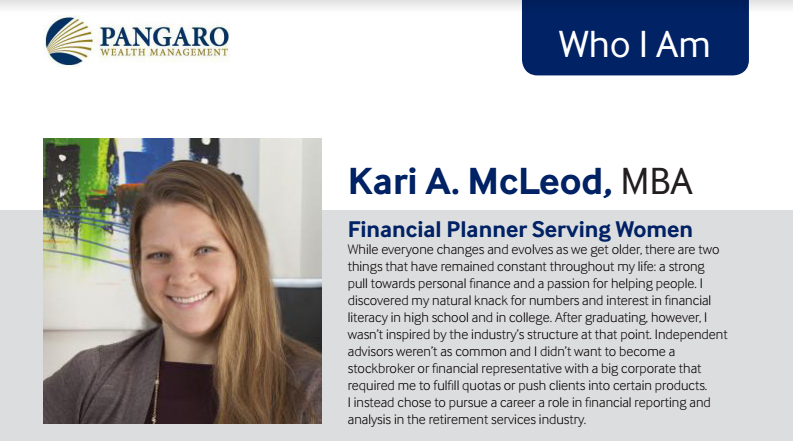
While everyone changes and evolves as we get older, there are two things that have remained constant throughout my life: a strong pull towards personal finance and a passion for helping people. I discovered my natural knack for numbers and interest in financial literacy in high school and in college. After graduating, however, I wasn’t inspired by the industry’s structure at that point. Independent advisors weren’t as common and I didn’t want to become a stockbroker or financial representative with a big corporate that required me to fulfill quotas or push clients into certain products. I instead chose to pursue a career a role in financial reporting and analysis in the retirement services industry.
Happy Halloween from Pangaro Wealth Management! Whether or not you have kids, it’s hard to deny the thrill of carved pumpkins, sugary treats, and dressed up ghosts and goblins. But for some, Halloween is just plain spooky.
The annual cost of providing healthcare for a family of four hit $25,826 in 2016, which is triple what it cost in 2001. That total includes $14,793 of employer contributions, $6,717 of employee-paid premiums, and $4,316 of out-of-pocket costs. Health care costs are not a trivial matter and can easily throw a family’s finances off track if they are not prepared. For those interested in saving towards health care costs, the government has provided an excellent tool: Health Savings Accounts (HSAs).
As the end of 2016 comes into sight, business owners everywhere are thinking of taxes. Which moves can be made to reduce your tax liabilities for the year? One popular option, especially for businesses with few to no employees, is to establish a Simplified Employee Pension (SEP) Plan.
I’ve often been asked why I entered this industry and became a financial advisor. Like many people, I didn’t grow up knowing what I wanted to be or what I wanted to do with my career. What I did know is that I liked the idea of solving complex problems with creative solutions. With the desire to tackle real-life problems and puzzles people often face, I entered the financial services industry in 1997.
Money may seem strictly analytical, but it plays a huge role in our emotional lives. According to a stress report conducted by American Psychological Association, nearly three-quarters of adults feel stressed about money at least some of the time, and almost one-quarter experience extreme stress about money. Emotions affect financial decisions we make, which can have an adverse impact in the long run, whether it’s taking too much risk with investments or not having proper insurance policies in place. Even though finances are the first thing people worry about, they’re also the last thing they feel comfortable talking about with their loved ones.
While everyone changes and evolves as we get older, there are two things that have remained constant throughout my life: a strong pull towards personal finance and a passion for helping people. I discovered my natural knack for numbers and interest in financial literacy in high school and in college. After graduating, however, I wasn’t inspired by the industry’s structure at that point. Independent advisors weren’t as common and I didn’t want to become a stockbroker or financial representative with a big corporate that required me to fulfill quotas or push clients into certain products. I instead chose to pursue a career a role in financial reporting and analysis in the retirement services industry.
I know this is a finance post, but before I jump into giving you a checklist for financial steps to take before and during divorce, I first want to say: Stay positive and remember you WILL get out of this. Positivity can carry you further than you’d ever imagine when the chips are down. It’s good for your brain, your body and your soul. When all those are all aligned, the financial steps become a non-emotional step in the process.
Include these steps in your overall retirement plan….
As moms, we all have that worry every.single.day whether we’re raising our kids proper enough to go off into the world and become well-rounded citizens. We watch what they eat, how they behave and what friends they keep—all while chauffeuring them to soccer and piano lessons. There’s one big lesson that we are all overlooking and not giving enough attention too: their relationship with money. Why is that? The medium most our world revolves around. Something most of these life lessons have an indirect relation to. My guess is because it’s a sensitive and ‘adult only’ conversation in the majority of households.
When I was in my twenties and newly married, I went to have a financial plan done with one of the popular investment firms in this vast marketplace. I ended up investing in a number of products I did not fully understand, including a variable life insurance policy and a long-term partnership fund. My hard-earned savings (which I thought was a lot at the time), quickly disappeared into the insurance policy–along with the monthly payments now due for the policy. The partnership and a number of small mutual funds never grew much. When making mistakes, the best part is learning from them, right? These are mine:
Well that was a pretty wild roller coaster yesterday, wasn’t it? How many times did you cover your eyes but peeked through your fingers? Did you immediately go to your account balances and cringe? If you did, that’s certainly ok—and a normal reaction. It’s also perfectly normal for you to have either called your advisor or thought about taking everything out yourself.
Ever read an article, watch a how-to YouTube video or a presentation at work and think ‘Well, I knew that already.”? Do you finish reading or keep listening? Most people do. And they sit and be quiet without asking or thinking about questions and initiating a more in-depth conversation.
Ever read an article, watch a how-to YouTube video or a presentation at work and think ‘Well, I knew that already.”? Do you finish reading or keep listening? Most people do. And they sit and be quiet without asking or thinking about questions and initiating a more in-depth conversation.
In most cases, you ARE going to have some prior knowledge about your finances, your goals, or suggestions your planner is already sitting across the table discussing with you. And that’s perfectly OK. No one wants to have a one-sided conversation rattling off a grocery list of items to do in order to get your financial plan in place.
So you’ve decided to start a new job, a new career or were told your position is being eliminated. What’s the VERY first thought that runs through your mind? It might a big *gulp*, and then it might be ‘will I be OK financially?’ First of all, let me tell you—the answer is YES. It’s happened to more people than you probably realize, and they all figure it out just fine.
Relationships come in all forms these days. With social media, working remotely, and online dating options, it’s easy for someone to say they have a ‘relationship’ with you. How many of these people have you actually met? As in, had an actual conversation with? It’s fine if the conversation has been over the phone, Face Time, or in person. The point is, you’re actually getting to know them beyond the easy “it’s so hot out today, isn’t?” To have a meaningful relationship with someone means that you actually care how they are doing, what drives them every day, and most of all, what makes them smile.
What is your plan for Long Term Care? The important thing is to have a plan and know there are options. Too often I see clients ignore the topic because Long Term Care insurance is “too expensive”. I agree. That’s why we look to alternative options to create a Long Term Care planning strategy. There are other options besides traditional Long Term Care insurance. If you have questions, please reach out to one of our Advisors.